
The Friday column: Addressing the state’s issues is not an either/or
Pursuing the AKLNG project and oil tax reform is not an either/or. Instead, especially given the size of the state's budget issues, the #akleg can and should pursue both, simultaneously.

While the dustup that surfaced at the end of this year’s two special sessions was over the extension of the existing state petroleum corporate income tax to petroleum S-corporations, we are concerned it may be just the beginning of a much larger issue: whether those opposing reforms to the state’s oil tax code will attempt to use the potential of an Alaska LNG project as an ongoing shield to block any changes to the state’s increasingly out-of-date approach to oil taxes.
If so, what transpired at the end of those sessions could be just the beginning of a prolonged battle that, as it continues, may detract from both the project and efforts to make significant strides in balancing the state’s budget.
Let’s begin at the beginning. On its current trajectory, Alaska is facing projected average annual current law unrestricted general fund (UGF) deficits over the next 10 years of over $2.3 billion. Here is the year-by-year outlook from Fiscal Year (FY) 2027 forward, based on the oil prices, volumes and other revenues included in the Department of Revenue’s (DOR) Spring Revenue Forecast, the most recent outlook for the annual percent-of-market-value (POMV) draw from the Permanent Fund and the Permanent Fund Dividend dervived from information published by the Alaska Permanent Fund Corporation, and spending levels derived from the most recent Fiscal Summary published by the Legislative Finance Division:
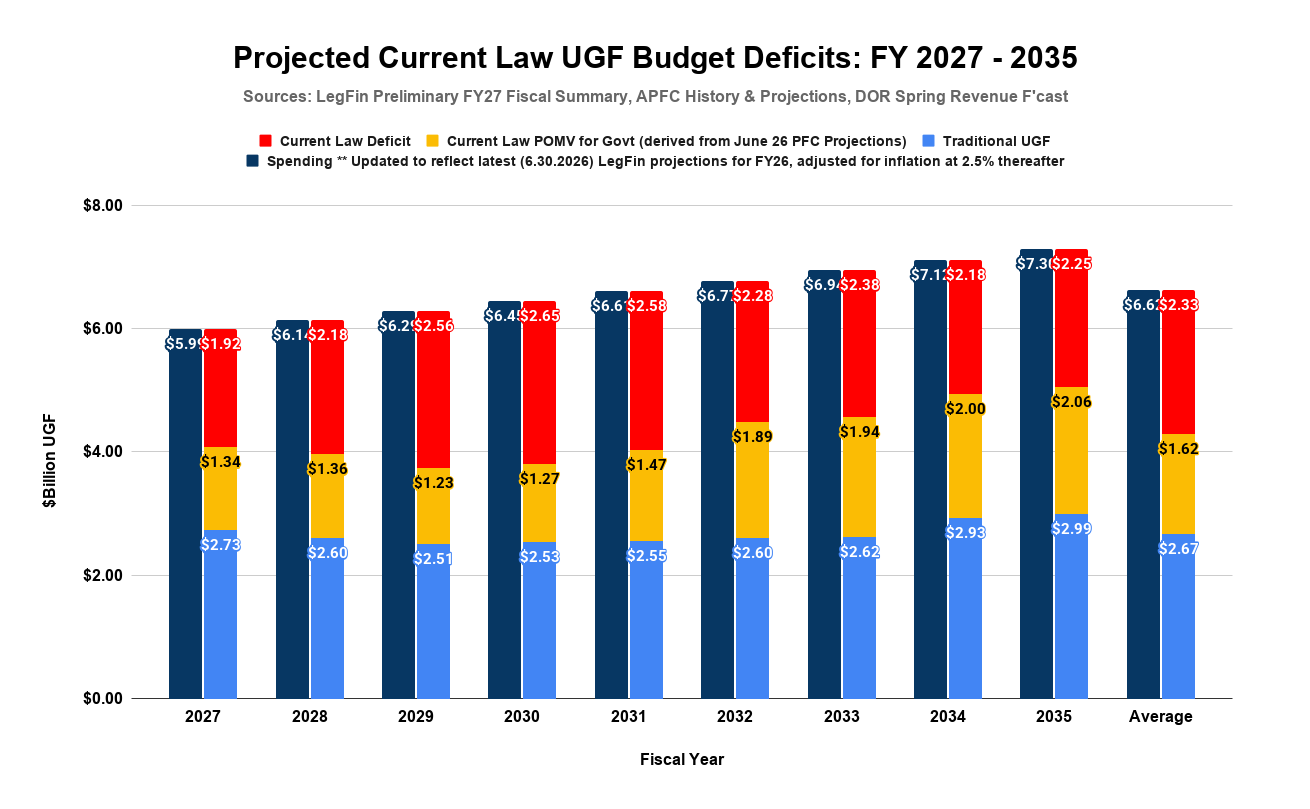
The projected deficits (in red) are substantial. On average over the period, they are over a third of spending, a deficit level that, as a percentage, exceeds even that of the United States government.
While there are several reasons for the budget gap, the fact that traditional revenues (light blue) largely flatline over the period is a significant factor. As the above chart indicates, on the current trajectory, while projected UGF spending increases over the period by nearly 22% (from $5.99 billion for FY2027 to $7.30 billion for FY2035), traditional UGF revenues (the light blue column) are projected to rise over the entire period by less than 10% (from $2.73 billion for FY2027 to $2.99 billion for FY2035). Compared to annual spending growth of 2.5%, that’s roughly only a little over 1% growth per year in traditional revenues.
That flatline in overall traditional revenues is driven almost entirely by the performance of oil revenues. Using the historic definition of traditional revenues - i.e., excluding the share of federal royalty revenues from the National Petroleum Reserve Alaska (NPRA) projected to be received by the state - overall oil revenues are projected to decline slightly over the period, from $1.87 billion in FY2027 to $1.86 billion in FY2035. Even including the newly added share of federal royalty revenues, overall oil revenues are projected to rise over the period by only 9% (from $1.88 billion in FY2027 to $2.05 billion in FY2035).
That, in turn, is almost entirely driven by the dismal performance over the period of production tax revenues. As the following chart shows, while production volumes are projected to jump between FY2026 and FY2035 by nearly 40% (from 466.8 thousand barrels a day (kbd) for FY2027 to 651 kbd for FY2035), production tax revenues collected from those barrels are projected to fall over the same period, first by as much as 63% between FY2026 and FY2033, before recovering some to a drop of still nearly 15% in FY2035 (from $524.2 million in FY2026 to $447.8 million in FY2035).
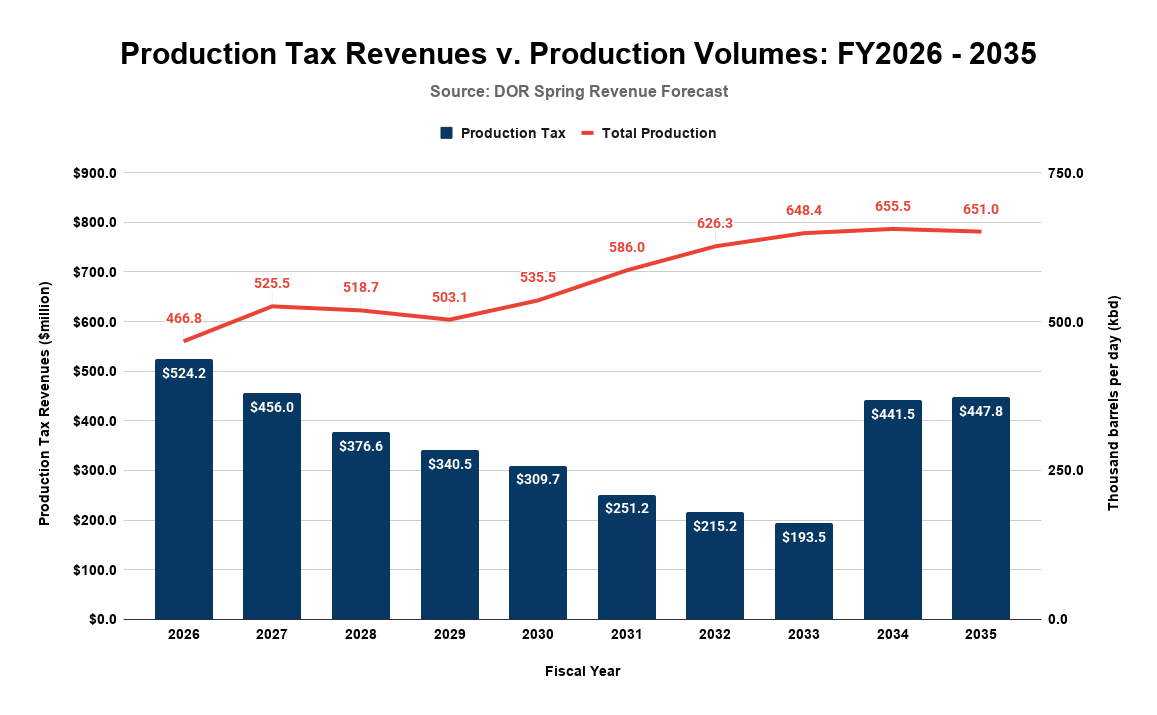
As we’ve explained in previous columns, there are better outcomes. Starting in FY2026, if production tax revenues rose only at the same rate as production volumes, they would be nearly $300 million higher by FY2035.
Viewed another way, for FY2026, the state currently receives about 5.5% of gross wellhead value (net of estimated royalty volumes) as production tax. If the tax level were reset instead, for example, at Oklahoma’s 7% of gross wellhead value (net of estimated royalty volumes), current (FY2027) revenues from production taxes would increase to about $750 million, approximately $300 million higher than current levels, and by FY2035, to approximately $910 million, roughly $460 million higher than projected levels.
There are other oil-related issues. While revenues from the petroleum corporate income tax are projected to climb materially over the period, they do not include any contributions from Hilcorp or other, similarly organized petroleum companies due to the S-corp issue. Recent estimates suggest that, if the S-corp loophole were closed and Hilcorp and the others were subject to the petroleum corporate income tax, current petroleum corporate income tax levels would rise by more than $120 million. If that grew just at the rate of projected inflation, the amount would be more than $150 million by FY2035.
Certainly, those steps alone are not enough to close the deficit, but they represent a material contribution.
Some argue, however, that such steps are an overreach and that, in the context of the Alaska LNG project, the Legislature should focus instead entirely on the additional revenues that project would produce.
According to DOR forecasts made during this year’s legislative hearings on the project, those potential revenues are indeed significant. Here are the projections made by DOR based on the version of the AKLNG bill as it was passed out of the Senate Finance Committee during the first special session, before the adoption of the S-corp amendment on the Senate floor.
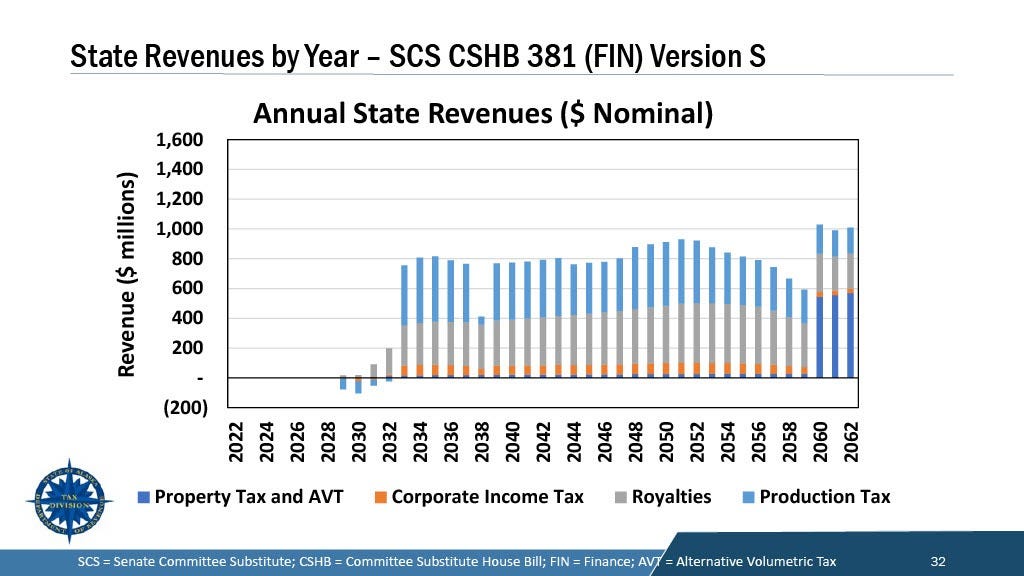
As the chart shows, if the AKLNG project is built and operates at full capacity, DOR projects that the project could be generating around $800 million in overall revenue to the state by FY2032.
But that number depends on some major “ifs,” and even then it still is not enough to close the huge budget gap facing the state. Indeed, even at that level it only reduces the average budget gap facing the state by only a little over a third.
Even combining the two sets of changes - first, making the changes discussed above to oil taxes, and second, achieving the full fiscal benefits of the AKLNG project - does not balance the budget. Even at their maximum level, and including the additional revenues from the AKLNG project realized by fixing the S-corp loophole, the state would raise only an additional $1.35 billion annually by FY2035, still significantly short of the projected $2.25 billion deficit.
But while the combination would not entirely close the deficit, it would reduce it materially, making whatever additional steps are required to finish the job less onerous than they otherwise are likely to be.
And by adopting the suggested oil tax reforms now, the state at least would achieve a material level of deficit offsets in the near term, regardless of the outcome of the AKLNG project. Reducing the state’s yawning budget deficits wouldn’t await and depend entirely on the significant “ifs” associated with the AKLNG project.
In that context, we view the recent efforts by Glenfarne, Hilcorp, and others to oppose the Senate’s proposed S-corp fix as counterproductive. While they are currently attempting to use the AKLNG project as a shield only against the proposed S-corp fix, it’s not a stretch to see them later raising the same issues in an effort to block any other needed reforms to the state’s oil tax code. Conceding now on the S-corp issue will only embolden those later efforts.
While developing the state’s gas resources is important, so is significantly reducing the state’s budget deficit. While not the only required step, oil tax reform - including fixing the S-corp loophole - is a necessary element of resolving it.
In their various statements, Hilcorp and the others essentially argue that the AKLNG project, on the one hand, and fixing the S-corp loophole (and, by implication, other needed changes in the state’s oil tax code), on the other, are mutually exclusive. It’s either one or the other.
In our view, however, the two objectives are not in conflict. In one way or another, Hilcorp and other S-corp owners already pay taxes on their oil income in other states in which they operate. And other Alaska producers pay a petroleum corporate income tax and still invest, indeed, are expanding their investment, in the development of Alaska’s resources. Indeed, Hilcorp’s own co-working interest owners in the Prudhoe Bay and Pt. Thomson fields pay a petroleum corporate income tax and still invest in those fields. It’s hard to imagine why extending the same tax to Hilcorp would adversely affect their investment levels in those and other fields when it has not done so to the other working interest owners, or companies such as Santos and Repsol who also are rapidly increasing their investment in the state.
Ultimately, the focus here should not be on accomplishing either the AKLNG project or oil tax reform to the exclusion of the other. Instead, the focus should be on accomplishing both.
To do so, the Legislature should reject any efforts by some to characterize the issues as an “either/or,” and to use one as a permanent shield from the second. Just like most likely can, in fact, walk and chew bubble gum at the same time, the Legislature should pursue both, simultaneously.
Thank you so very much Mr. Keithley for continuing to get all of this out to the us Alaskans. One would think that most of our legislators would be on the same page, but sadly they are not. Your argument to begin taxing the S Corporations make just perfect sense. What a shame that it is lost on so many. Please keep it up though in hopes that it will finally one day begin to seep into their apparently incredibly thick skulls.